Small Garden Layout Ideas That Make Outdoor Space More Usable
A small garden is the reality for most South West homeowners, and new-build plots can be smaller still. Compact does not have to mean cramped.
With the right layout, a modest patch can feel roomy, tidy and genuinely useful, and you rarely need to demolish anything to get there.
These small garden layout ideas focus on smart paving and landscaping that make the most of every metre, so your outdoor space works as hard as the rooms inside.
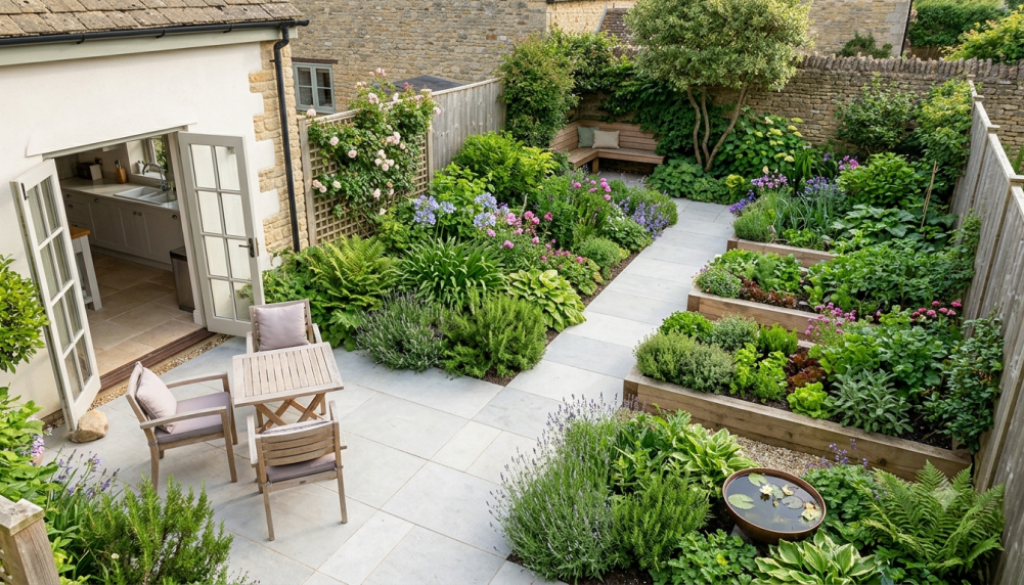
Divide the Space Into Zones
The most common mistake in a small garden is treating it as one open patch. When you can see every corner from the back door, the eye takes in the boundaries at a glance and the space feels small.
Splitting the garden into two or three zones fixes that. Oddly, two small areas feel more generous than one open space of the same size, because each one reads as a complete room rather than a fraction of something larger.
You do not need walls to do it. Zones can be marked by:
- A change of surface, such as paving giving way to gravel.
- A single step or a low raised bed.
- A line of planting or a slim screen.
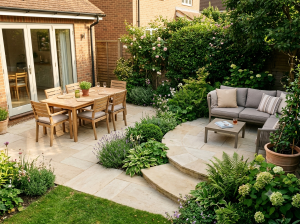
Think about the jobs your garden does, then give each one a spot: a dining area near the house, a quiet seat further down, a small growing patch in a sunny corner. A patio zone by the back door is usually the natural anchor for the whole layout.
Use the Diagonal to Stretch the Space
Here is a designer’s trick worth knowing: the diagonal is the longest line across any square. Laying your paving at 45 degrees to the house, rather than square to the walls, draws the eye along that longer line and makes the whole garden feel wider than it measures.
The same idea works for paths and bed edges. A route that crosses the garden corner to corner, instead of running straight to the back fence, adds a sense of journey and depth. In a square or boxy plot, angling the main paved area also creates neat triangular pockets in the far corners, ready for planting.
It is one of the cheapest ways to make a small garden feel bigger, since it costs nothing extra beyond a little planning at the design stage.
Keep Pathways Simple and Purposeful
Paths do two jobs in a small garden: they get you from one spot to another, and they guide the eye. Too many of them chop the space up and make it feel busy.
Keep to one clear route, wide enough to walk comfortably, and let it lead somewhere worth reaching, such as a seat or a feature pot. A path that curves gently or runs at an angle feels longer than a straight, short dash to the fence.
For the surface, matching or complementing your main paving keeps the look joined up. Stepping stones set into gravel or planting soften a route without the solid weight of a full path, which suits tight spaces where every metre counts. Keep the route slightly off-centre rather than dead straight, and it feels like part of the design instead of a line drawn to the fence.
Add Height With Raised Beds and Borders
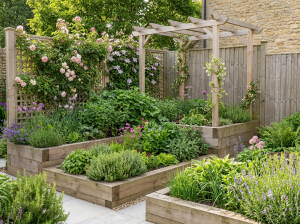
When floor space is limited, the answer is often to go up. Raised beds and deeper borders are some of the most useful features in a small garden, and they earn their place several times over.
A raised bed defines a zone, improves drainage and growing conditions, and adds a layer of height that pulls the eye away from a bare fence. Deep borders, rather than a thin token strip, let you plant in layers, so the boundary disappears behind greenery instead of stopping the eye two metres from the door.
Climbers on a trellis, an arch or a slim pergola lift planting higher still without using precious floor space. Height is what turns a flat, boxy plot into something with depth and interest.
Choose Surfaces That Keep the Layout Clean
Clutter on the ground makes a small garden feel smaller, so a clean, considered surface matters more here than anywhere.
Three simple rules help:
- Stick to one main material and, at most, one secondary one. More than two looks fragmented and draws attention to every join.
- Choose larger slabs where you can. Fewer joints mean fewer lines breaking up the floor, which reads as more open.
- Lean toward paler tones. Light paving reflects more light and lifts shaded corners, while dark surfaces soak it up and press in.
A seamless finish such as resin-bound paving takes this furthest, with no joint lines at all, which is why it suits compact courtyards and narrow side returns so well.
Make Seating Areas Earn Their Place
In a small garden, every feature should do more than one job, and seating is the easiest place to start.
A built-in bench along a raised bed gives you somewhere to sit, a ledge for pots, and often storage underneath. Folding bistro furniture tucks flat against a wall when the space is needed for something else. An extending table copes with a quiet coffee for two or a gathering of six.
Position your main seat to catch the evening sun and, where you can, tuck it slightly out of sight of the back door.
Having to walk a few steps to reach it adds that sense of a separate, tucked-away spot, which makes even a tiny garden feel like it has more to explore.
Built-in seating also frees up the floor that free-standing furniture would otherwise eat into, which is a real gain when space is tight.
Planning a compact garden makeover? Ominiworks offers free surveys and quotes across the South West, so you can shape a small space that finally works the way you want.
FAQs