

When to Sealcoat an Asphalt Driveway Before Long Island Winter Sets In
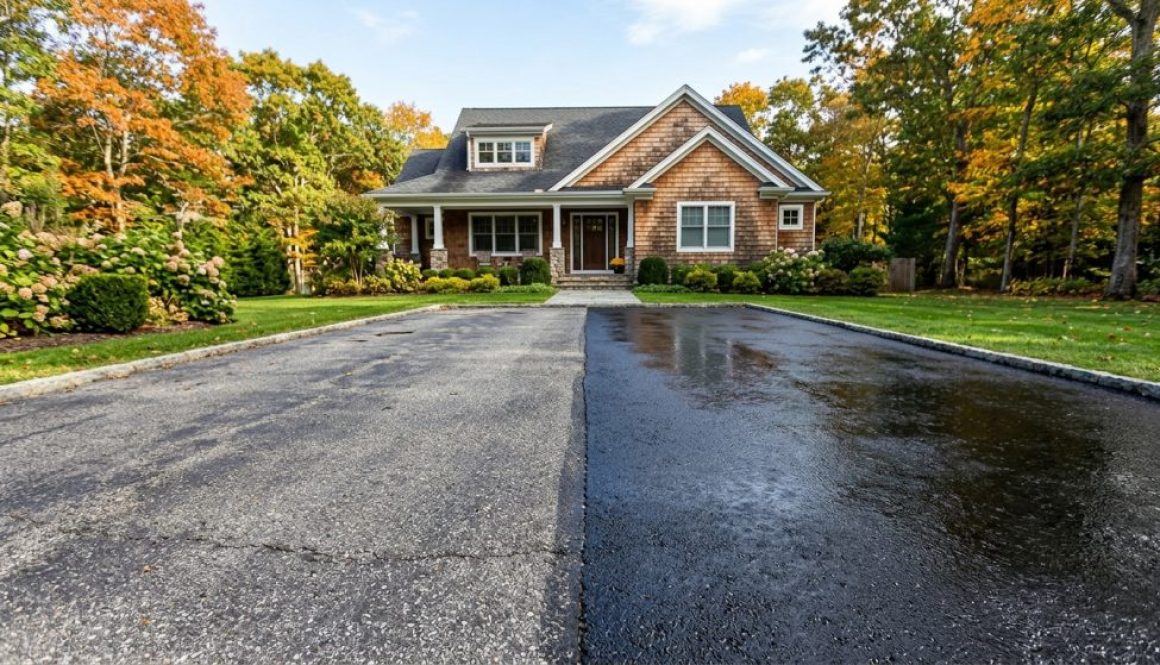
A driveway that has faded from black to pale gray is telling you something specific. The binder holding the aggregate together is drying out under years of sun exposure, and a dried binder loses its flex. Leave a rubber band on a sunny windowsill for a summer and it stiffens until it snaps at the first stretch. Asphalt behaves the same way, just slower. Sealcoating slows that process, but only if it goes down while conditions still allow it to cure.
What Sealcoating Actually Does
Sealer is a thin protective coating applied over an existing asphalt surface. Understanding its job prevents both skipping it unnecessarily and expecting it to solve problems it was never meant to handle.
The Protection It Provides
Sealer forms a barrier between the asphalt and the things that break it down. Ultraviolet light oxidizes the binder and makes the surface brittle. Gasoline, motor oil, and transmission fluid dissolve it directly. Water works its way into surface pores, then freezes and expands.
A sealed surface also sheds water more readily instead of absorbing it, which matters a great deal in a climate that cycles above and below freezing repeatedly between December and March.
What It Will Not Fix
Sealer is a coating, closer to paint on a fence than a repair to the fence itself. It has no structural value.
- It does not fill cracks. Crack filling is a separate step with a separate material.
- It does not level depressions or correct drainage problems.
- It does not repair alligator cracking, which signals base failure underneath.
- It does not add strength to a driveway that flexes under vehicle weight.
Applying sealer over any of these hides the symptom for a season while the underlying condition keeps advancing. If your driveway shows soft spots or standing water, asphalt driveway repair needs to come first.
The Temperature Window That Controls Fall Sealcoating
Sealer is water based, and water based products need warmth to cure. This is the single factor that closes the sealcoating season, and it closes earlier than most homeowners assume.
Why 50 Degrees Is the Common Threshold
Most manufacturers specify application when air and surface temperatures are at or above 50 degrees Fahrenheit and rising, with no rain expected for at least 24 hours. Below that, the water in the emulsion evaporates too slowly. The coating stays soft, cures unevenly, and can peel or track under tires the following spring.
Night Temperatures Matter More Than Afternoon Highs
A mild 60 degree October afternoon can be misleading. If temperatures drop into the low 40s overnight, a coating applied at two in the afternoon has only a few useful curing hours before the surface cools past the point where curing effectively stops.
This is why a contractor may decline an October date that looks perfectly reasonable on a forecast app. They are reading the overnight lows, not the daytime highs.
Why Early Fall Suits Long Island Driveways
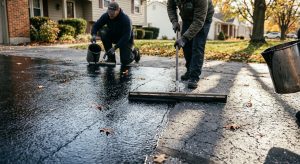
September offers a combination of conditions that neither midsummer nor late fall provides.
- Reliable curing temperatures. Days and nights both stay comfortably above the working threshold.
- Lower humidity. Drier air speeds evaporation, so the coating sets in hours rather than lingering tacky.
- Reduced surface heat. Sealer applied to pavement baking at 130 degrees in July can flash-dry on top before the layer beneath sets, which weakens adhesion.
- Protection in place before winter. A cured coating heading into December is doing its job during the months that cause the most damage.
- Time to handle repairs first. Crack filling needs its own cure period before sealer goes over it, and September leaves room for both steps.
Repairs That Come Before the Sealer
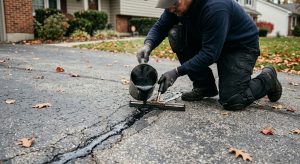
Sealing over a dirty or damaged surface wastes the material. A proper sequence looks like this.
- Clean the surface thoroughly. Dirt, sand, and loose material prevent adhesion. Any vegetation growing through cracks gets removed at the root.
- Treat oil and fluid stains. Petroleum residue stops sealer from bonding. Stained areas need degreasing and sometimes a primer.
- Fill cracks. Anything roughly a quarter inch or wider gets a flexible crack filler that can move with seasonal expansion.
- Patch potholes and broken areas. These need proper repair rather than a coating over the top.
- Allow cure time. Crack filler and patches need to set before sealer is applied over them.
- Apply the sealer. Usually two coats, with drying time between them.
Skipping straight to step six is what produces a driveway that looks excellent in October and shows every old crack again by April.
Choosing Between Sealing, Crack Filling, and Resurfacing
These three services get confused often, and choosing the wrong one wastes money. Each addresses a different stage of wear.
| Sealcoating | Crack filling | Resurfacing | |
| What it addresses | Surface oxidation, water absorption, fading | Individual cracks letting water into the base | Widespread surface deterioration |
| Structural value | None | Minimal, but prevents base damage | Adds a new wearing layer |
| Right when | Surface is sound but graying | Cracks are open but the base is solid | Cracking is widespread, base still stable |
| Typical frequency | Every few years | As cracks appear | Once per driveway lifespan, sometimes twice |
How Often Asphalt Should Be Sealed
More frequent is not better. Sealing every year builds up layers that become thick and brittle, and thick sealer cracks in its own right, producing a spiderweb pattern across the surface that has nothing to do with the asphalt underneath.
Most residential driveways do well on a cycle of every two to three years, adjusted for sun exposure, tree cover, and traffic. A driveway shaded most of the day oxidizes more slowly than one facing open southern sun. A useful check: if water still beads on the surface, the existing coating is doing its job.
New asphalt is a separate case. A freshly installed driveway needs time to release its oils and harden before it can accept a coating, which generally means waiting until the following season. Sealing too early traps those oils and keeps the surface soft.
Coal Tar Sealers Are No Longer Legal in New York
This is worth knowing before hiring anyone, because it separates current contractors from those working off old habits.
New York prohibited the sale of pavement products containing coal tar in November 2022, and prohibited applying them in November 2023. The restriction stems from polycyclic aromatic hydrocarbons in coal tar sealers, which wear off as dust and carry into soil, waterways, and homes.
Asphalt-based sealers are the legal alternative and are widely available. If you are unsure what a contractor plans to use, you can ask for the product’s safety data sheet. Any reference to coal tar or refined coal tar means the product cannot legally be applied in New York State.
When Sealing Is No Longer the Right Answer
Some driveways have passed the point where a coating helps. These signs suggest a different conversation.
- Interconnected cracking across large areas rather than isolated lines
- Sections that move or feel spongy under a vehicle
- Water pooling in the same spots after every rain
- Potholes reappearing in previously patched areas
- Edges that have crumbled away with no support remaining
At that stage, sealing is money spent on appearance. Homeowners in this position are usually better served by discussing resurfacing or replacement with asphalt paving contractors in Farmingville or comparable local specialists before committing to a coating.
Schedule Sealcoating While the Weather Still Allows It
Stonerock Paving & Masonry handles driveway maintenance and repair across Suffolk and Nassau County, including asphalt services in Medford and driveway paving in Holtsville. The team will tell you honestly whether your driveway is a good candidate for sealing this fall or whether repairs should come first, rather than coating over a problem.
Call (631) 920-3618 or book a free driveway assessment while temperatures still support proper curing.
