
Tree Roots Lifting Your Driveway: Repair or Replace?
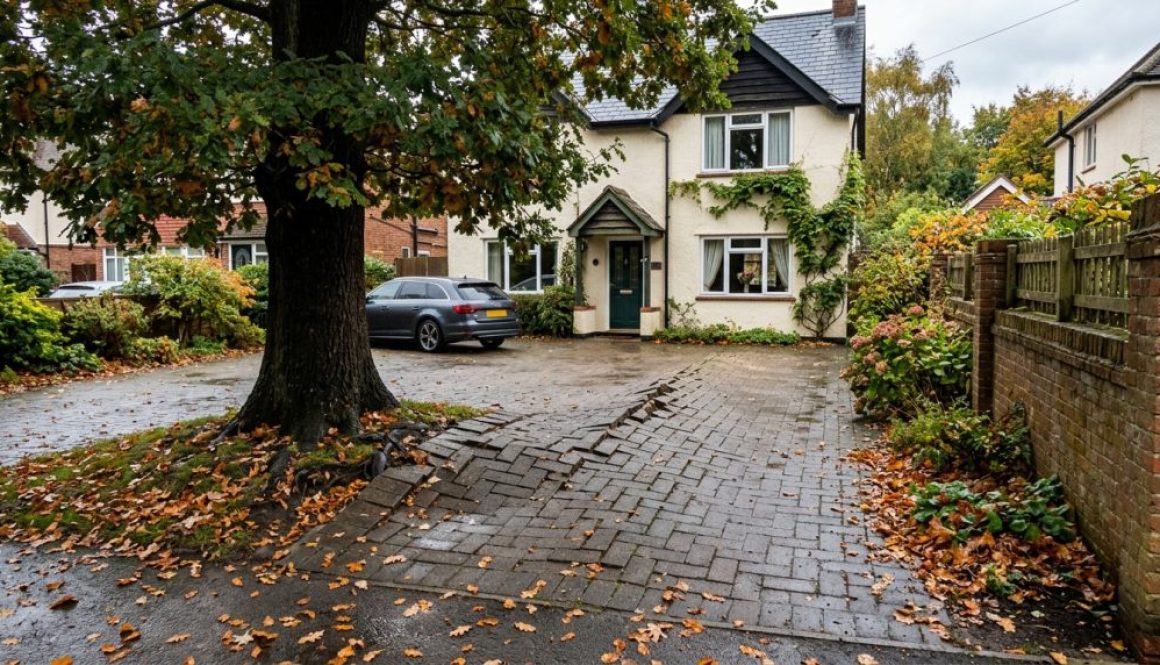
A ridge has appeared across the driveway. Blocks near the base of the tree sit proud of everything around them, one paving slab has tilted enough to catch a shoe, and the crack you filled last year has opened again in the same place.
The instinct is to deal with the tree. Before you do, two things are worth knowing. Cutting roots on a protected tree is an offence in its own right, whatever your reason for digging. And removing the tree can create a second, more expensive problem on clay soil, because the ground takes water back up once nothing is drawing it out and swells in response.
Root damage is usually fixable. The order you tackle it in decides whether the repair lasts.
What Roots Are Actually Doing Down There
Two separate mechanisms get lumped together under root damage, and they need different answers.
The first is physical. Roots grow where resistance is lowest and where water, air and nutrients are easiest to reach, which often means the loose granular layer beneath a driveway. As a root thickens it pushes the surface up. This produces the classic ridge running away from the trunk, with sound paving either side.
The second is moisture. Trees draw large volumes of water out of clay soil through the growing season, which shrinks the ground and drops whatever sits on it. This produces the opposite symptom: a dip rather than a ridge, usually seasonal, worst at the end of a dry summer.
One tree can cause both at once, in different parts of the same driveway. Telling them apart matters because lifting is a construction problem and shrinkage is a ground problem, and the second one does not go away by relaying the surface.
Check the Tree’s Status Before Anything Else
This step costs a phone call and prevents the worst outcome on the list.
Trees covered by a Tree Preservation Order cannot be cut down, topped, lopped, uprooted or wilfully damaged without the local planning authority’s written consent. Government guidance is explicit that cutting roots counts as a prohibited activity and needs consent as well. The protection applies below ground just as it does to the canopy, so an excavator taking out a driveway base can breach an Order without anyone touching the tree itself.
The penalties are not nominal. Cases in a magistrates’ court carry fines of up to £20,000 for each offence, and serious cases heard in the Crown Court carry an unlimited fine.
Trees in conservation areas that are not already covered by an Order have their own requirement: six weeks’ written notice to the local planning authority before work begins, which gives the authority the chance to make an Order if it thinks the tree warrants one.
There is no national register, so the check is always local. In most of Somerset and Devon that means the district or unitary council. Within Exmoor National Park the National Park Authority acts as the planning authority and handles tree consents for the area, which catches out homeowners on the Somerset side who assume the county council holds everything.
The Root Protection Area Sets the Design
Where a tree is being retained, and most are, the design question becomes how much of the rooting environment stays undisturbed.
The British Standard for trees in relation to design and construction gives a working figure. For a single stem tree, the root protection area is a circle with a radius of twelve times the stem diameter, measured at 1.5 metres above ground, with the resulting area capped at 707 square metres for very large trees. Inside that circle the standard recommends no excavation, no change of soil level and no compaction.
The numbers grow quickly. A tree with a stem 500mm across gives a six metre radius, an area of roughly 113 square metres. Double the stem and the radius reaches twelve metres. A single mature tree can easily have a protection area covering an entire front garden, which is why a conventional dig-and-fill driveway is often the wrong specification rather than simply an expensive one.
Reading the Damage
|
What you can see |
Likely mechanism |
What it changes |
|
Ridge running outward from the trunk, sound paving either side |
A thickening root beneath the base |
Surface can often be rebuilt over the root without cutting it |
|
Dip that deepens through summer and recovers in winter |
Moisture withdrawal from clay soil |
Relaying alone will not hold, the ground needs addressing |
|
Cracked slabs directly above a visible surface root |
Point loading over an uneven base |
Localised rebuild, usually with a more forgiving surface |
|
Damage concentrated along a drain run |
Roots drawn to a leaking joint |
Fix the pipework first, or the roots come back |
|
Blocks lifting near the boundary with a street tree |
Roots from a tree you do not own |
Council tree team involved before any work |
That fourth row is worth dwelling on. Council tree officers make the point regularly that roots are opportunistic and are drawn towards water escaping from an old pipe with failing joints. Replace the pipework with modern materials, the leak stops, and the reason the roots concentrated there disappears. The tree gets blamed for a drainage fault more often than it deserves.

Why Felling Is Rarely the First Answer
Removing a mature tree from clay ground can produce heave. The soil that had been kept dry by the tree rehydrates over the following seasons and swells, lifting whatever sits above it. On a driveway this can be worse than the original problem, and it arrives after the money has been spent. This is the same seasonal behaviour that shows up when paving moves as autumn rain returns, amplified by a sudden change in what the ground is doing.
Removal is sometimes the right call. It should follow arboricultural advice rather than lead the project, and it should account for what the ground will do afterwards.
Repair, Rebuild or Redesign
Three realistic routes, in increasing order of cost and permanence.
Localised repair. Lift the affected area, adjust the laying course, relay. Sensible where the root is stable, the tree is small, and the movement is not progressing. Expect to repeat it eventually.
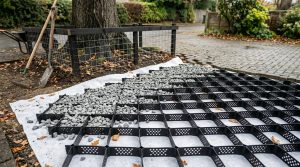
No-dig rebuild over the roots. The standard engineering answer for hard surfacing inside a root protection area. Instead of excavating, the new surface is built up over the existing ground on a geotextile separation layer with a cellular confinement system or geogrid holding clean angular stone. Load spreads sideways rather than pressing down into the soil, so the roots are neither cut nor compacted. It raises the finished level, which has to be designed around thresholds and gullies, and it works.
Full redesign. Where the layout puts parking directly over the part of the root protection area that matters most, moving the parking is cheaper over ten years than rebuilding the same driveway three times. Resin bound and permeable block systems both sit well on no-dig build-ups, and both let water reach the roots rather than sealing them off.
Whichever route applies, the base decides the outcome, which is why the layer under paving matters more than the surface on top.
What to Do Before Winter
- Photograph the ridge or dip with a straight edge across it and date the image, then repeat in three months. Seasonal movement and root lift look identical in a single photo.
- Check the tree’s status with your local planning authority, and with the National Park Authority if you are inside Exmoor.
- Ask for the drain run to be checked if damage follows a line rather than radiating from the trunk.
- Get arboricultural advice before any pruning or removal is priced, not after.
- Avoid cutting anything you find while investigating. A root exposed during a dig is easy to sever and difficult to explain afterwards.
Ominiworks works around retained trees regularly across Somerset and Devon, including driveway installation and resurfacing built over root protection areas rather than through them. If a tree is moving your driveway, call 0800 999 1367 or arrange a free site survey and we will look at the ground, the tree and the drainage together before recommending anything.