Why Cheap Driveways End Up Costing More (And How to Avoid It)
A cheap driveway can look like a smart decision at first. Lower upfront cost, quick turnaround, and a finished surface that seems acceptable. But the problem with cheap work is that it often hides what has been left out.
You are not paying less for the same job. You are paying less because parts of the job are missing. That difference only becomes clear over time.
What Gets Cut In A Cheap Installation
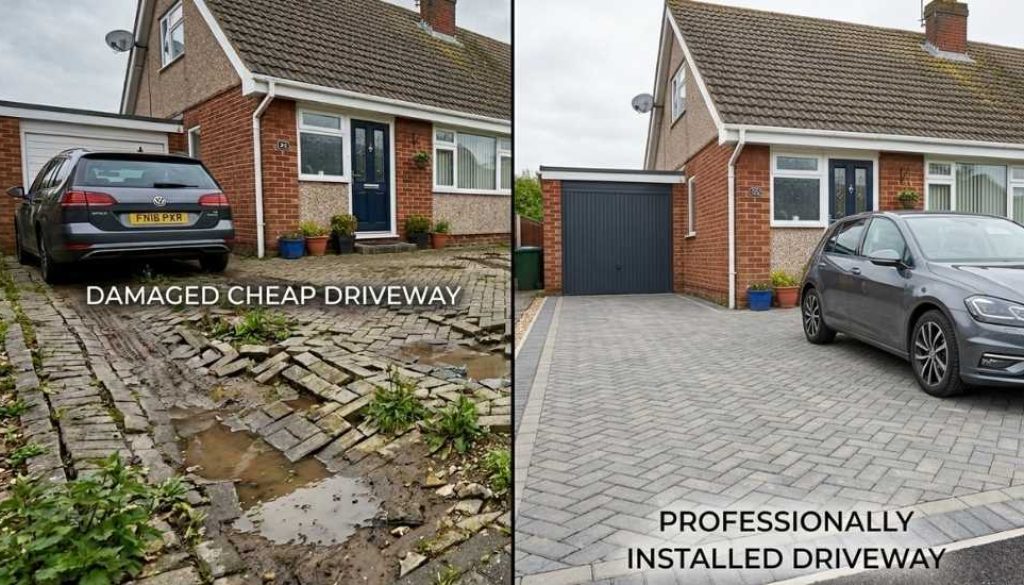
At first glance, a driveway can look solid and well-finished. The surface is smooth, the lines are straight, and everything appears “done.” But the real test sits beneath that top layer. Cheap installations often look fine for a few months, then quietly start to fail because critical steps were rushed or skipped.
Reduced Excavation Depth
Proper excavation is not just digging out soil. It is about creating enough depth to hold multiple structural layers that carry weight over time. A shallow dig means there is no room for a stable sub-base or proper compaction.
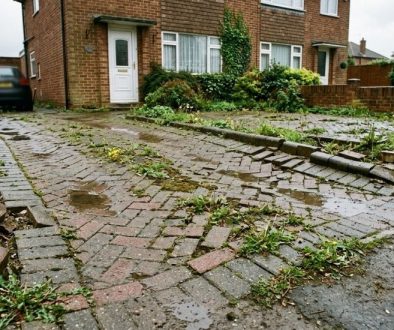
What happens next is predictable. The driveway begins to flex under pressure, especially where cars regularly turn or park. You might notice slight dips at first, then more obvious sinking. It is like building a bookshelf on soft carpet instead of a solid floor. It stands for a while, then slowly leans.
Weak Sub-Base Installation
The sub-base is the load-bearing layer. It spreads the weight of vehicles across the ground so no single point takes too much pressure. In cheap jobs, this layer is often too thin, made from poor-quality aggregate, or not compacted in stages.
Without proper compaction, air pockets remain trapped inside. Over time, these collapse under weight and moisture.
This leads to:
- Localised sinking where tyres sit most often
- Hairline cracks that widen with seasonal movement
- An uneven surface that collects water instead of shedding it
A strong sub-base should feel boringly solid. If it is rushed, the entire driveway becomes a slow-motion failure.
No Drainage Planning
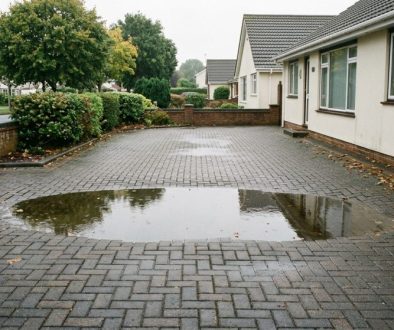
Water is the quiet cause of most driveway problems. Without planned drainage, rainwater has nowhere to go. It seeps into joints, softens the base, and weakens the structure from below.
In the UK climate, this gets worse with freeze-thaw cycles. Water expands when it freezes, pushing materials apart. Then it melts and leaves gaps behind. Repeat that process enough times and even a new driveway starts to break down.
You may notice:
- Puddles that sit long after rain
- Edges that begin to crumble
- Moss or algae forming in damp areas
Proper installations include subtle gradients, channel drainage, or soakaways. These are not extras. They are essential.
Lower Quality Materials
Cheaper materials do not just affect how a driveway looks. They directly impact how it performs under daily use.
Low-grade blocks can fade quickly and lose their finish. Poor resin mixes may become brittle or discolour. Inferior aggregates break down faster under pressure, reducing the strength of the entire system.
Over time, this shows up as:
- Surface wear in high-traffic areas
- Colour inconsistency or fading patches
- Loose or shifting sections
It often becomes a cycle of small repairs that never fully solve the issue.
Why It Looks Fine at First
Most poor installations do not fail immediately. The surface can appear solid and clean after completion. Problems develop gradually as the base begins to shift.
This delay creates a false sense of value. By the time issues appear, the installer is often no longer involved.
The Long-Term Cost Breakdown
Cheap work rarely stays cheap.
Over time, you may face:
- Repairs within the first year
- Ongoing maintenance to manage issues
- Partial or full replacement
When combined, these costs often exceed what a proper installation would have required initially.
The Hidden Stress of Repeating The Job
The financial cost is the obvious problem. The part most homeowners underestimate is the disruption that follows. A driveway is meant to be a one-and-done project. When it fails early, it pulls you back into a process you thought was finished.
Fixing a failed installation is rarely a quick patch. In most cases, it means removing sections or even starting again from the base. That brings back all the disruption you already went through the first time.
You end up dealing with:
- Chasing contractors for quotes, timelines, and availability
- Rearranging your schedule to be home for surveys or site visits
- Comparing options again, often with less trust than before
There is also the day-to-day inconvenience. Noise returns. Access to your property becomes awkward again. Parking may need to be moved elsewhere. Deliveries become harder to manage. What was once a completed space turns back into a work zone.
For families, it affects routine. For anyone working from home, it becomes a constant interruption. Even something as simple as getting in and out of your driveway starts to feel like a hassle.
Then there is the mental side of it. Repeating the job creates doubt. You second-guess decisions, question materials, and worry whether the next contractor will actually fix the issue or just cover it up again. It is a bit like repainting a wall that keeps peeling. You are no longer focused on improving the space. You are just trying to stop it from getting worse.
In many cases, the second job is more involved than the first. Proper contractors often need to undo poor groundwork before they can rebuild it correctly. That adds time, cost, and complexity that could have been avoided from the start.
What Quality Work Actually Includes
Understanding what you should be paying for helps you avoid poor decisions.
A properly installed driveway includes:
- Full excavation to the correct depth
- Strong, compacted sub-base
- Planned drainage solutions
- High-quality surface materials
- Skilled installation
Each step contributes to long-term durability.
How Ominiworks Approaches Value
At Ominiworks, value is measured by how long the work lasts.
The focus is on:
- Getting the groundwork right
- Using materials suited to the job
- Delivering consistent, high-quality finishes
This approach reduces the need for future repairs and protects your investment.
How to Spot a Cheap Job Before It Starts
Avoiding problems is easier than fixing them.
Look out for:
- Quotes that are significantly lower than others
- Lack of detail about groundwork
- No mention of drainage
- Pressure to make quick decisions
A reliable contractor explains the process clearly. If details are missing, it is worth asking why.
Choosing the Right Contractor
The goal is not to find the cheapest option. It is to find the right one.
Consider:
- Experience with similar projects
- Clear communication and transparency
- Proven results
- Confidence backed by a guarantee
These factors indicate a contractor who takes the work seriously.
Pay Once, Not Twice
A driveway is not a short-term feature. It should last for years without constant attention.
Choosing quality from the start avoids unnecessary cost and stress. At Ominiworks, the focus is on building driveways that hold up over time, not on the day they are finished. Book a site visit today.