

Why Paving Moves When Autumn Rain Returns After a Dry Summer
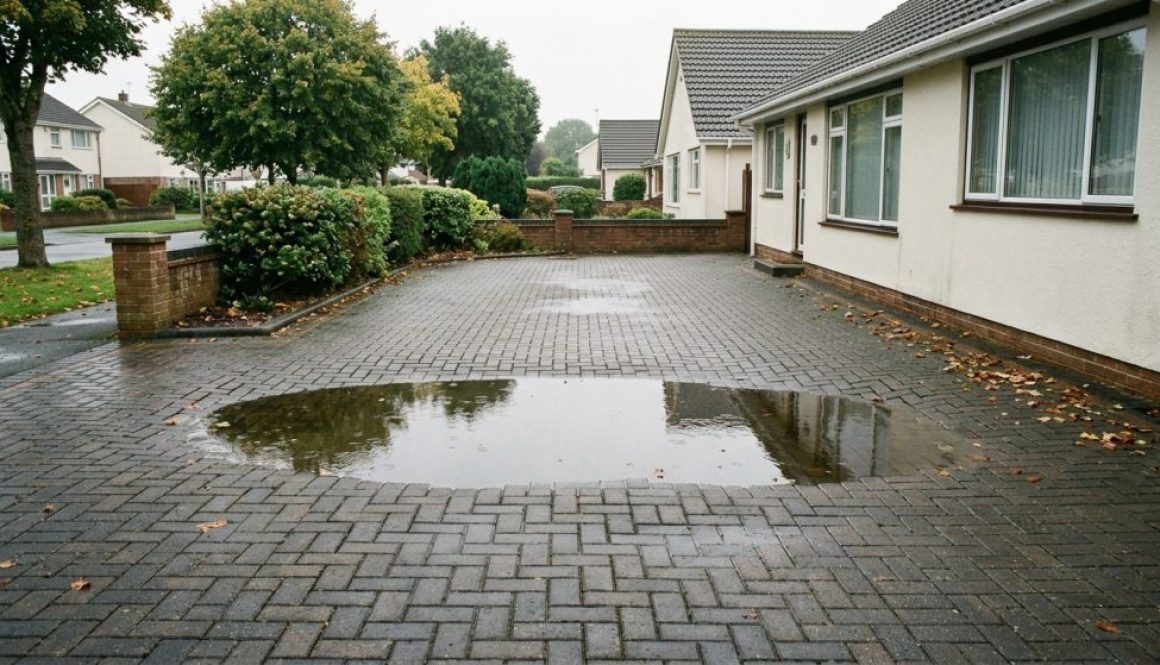
Your patio was fine in July. Now a slab rocks underfoot, a joint has opened along one edge, and there is a shallow dip in the driveway that fills after every shower. Nothing has hit it. Nobody has parked badly on it. The change arrived with the rain.
Most of the time this is the ground rather than the surface. Soil beneath a patio or driveway shrinks through a dry summer, then takes water back on through autumn, and whatever sits on top has to move with it. Some of that movement is normal and will reverse. Some of it is a sign that the base under your paving was never built to cope. Telling those two apart decides whether you need a small repair or a rebuild.
What Happens Under Your Paving in September
Clay soils change volume with moisture. The clay minerals absorb water and swell, then lose it and shrink. The British Geological Survey describes this shrink and swell behaviour as one of the most damaging ground hazards in Britain, costing the economy an estimated £3 billion over the past decade, and points out that most of us see it in our own gardens: cracked ground in summer, heavy ground in winter. The same soil, a different volume.
Seasonal moisture change is usually concentrated in the upper one and a half to two metres of ground, which is exactly the zone your paving sits on. Through a long dry spell the soil pulls away and settles. When rain returns, it swells again and pushes back up, rarely by the same amount everywhere.
Paving cannot flex the way soil does. Rigid slabs bridge across a hollow until something gives at the weakest joint. Block paving is more forgiving because each unit moves independently, which is why block surfaces tend to dip and ripple rather than crack.
Normal Settlement or a Failing Base
Every new surface beds in slightly during its first year. Seasonal movement is different again: it comes and goes, and by the following summer the surface sits roughly where it started. Failure behaves differently. It travels in one direction, gets a little worse each year, and does not recover when the weather changes.
Three questions separate them:
- Does it come back? If a slab rocks in October and sits firm again in June, the soil is moving. If it never firms up, something below has been displaced.
- Is it worse than last year? Progressive change points at the base rather than the season.
- Is water involved? Movement that centres on a downpipe, gully or drain run is rarely soil behaviour on its own.
Reading the Warning Signs
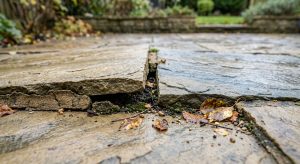
A quick look tells you more than most homeowners expect. This table covers what people usually notice first and what tends to sit behind it.
| What you can see | Most likely cause | How urgent |
| Slabs rock in wet weather but sit level when dry | Seasonal moisture movement in the soil below | Monitor through the season |
| One area drops a little lower every year | Sub-base too thin or poorly compacted | Get it assessed |
| A dip that holds water long after rain stops | Falls lost through settlement, so water now runs the wrong way | Deal with it before winter |
| Blocks working loose along an open edge | Edge restraint failed or was never installed | Deal with it before winter |
| Cracks in rigid slabs spreading from one point | A void underneath and load concentrated above it | Get it assessed |
| Sunken ground beside a gully, drain or downpipe | Water escaping and washing fine material out of the base | Treat as urgent |
That last row matters more than it looks. Water escaping below ground removes material rather than compressing it, so the hollow keeps growing quietly until the surface drops all at once.
Why South West Gardens Behave Their Own Way
Somerset gives an unusually clear demonstration of ground movement, and you can feel it from a car. Across the Levels, drained peat degrades and shrinks, lowering the land surface by as much as two centimetres a year according to Somerset Wildlife Trust, with periodic shrinkage and winter rewetting producing the bumps and slumps that anyone driving the moor roads knows well. Those roads ride the ground rather than sitting on it. A garden path or a driveway does the same thing on a smaller scale.
Away from the Levels, gardens across Somerset and Devon sit on a mix of clay-rich alluvium, shallow soil over shillet, and made ground left behind by older building work. The British Geological Survey notes that superficial deposits including alluvium, peat and laminated clays can all be susceptible to subsidence and heave. Two houses on the same street can behave differently if one garden was built up with imported material decades ago and the other was not.
This is one reason why a patio base matters more than the slabs on top. The same surface performs well on one plot and moves on another.
What Makes Seasonal Movement Worse
A few things reliably amplify what the soil is already doing:
- Mature trees and hedges close to the surface. Roots draw large volumes of water out of clay through the growing season, deepening the summer shrinkage nearest the paving.
- Changes to where rain reaches the soil. BGS advises considering the effect of laying impermeable drives, paths and hardstanding on the moisture reaching the ground below. Cover part of a garden and the soil beneath dries differently to the soil beside it.
- Old drainage runs. Clay pipework cracks more readily under ground movement, and a cracked pipe then feeds water into the very ground that moved it.
- A thin or poorly compacted sub-base. Ground movement finds the weakest layer, and an under-built base is always the weakest layer. This is the pattern behind most failures that appear after a wet season.
- Missing edge restraints. Without a firm edge, block paving spreads sideways every time the ground beneath it swells.
- Falls that were too shallow to begin with. A surface laid nearly flat has no margin. A few millimetres of settlement is enough to reverse where the water goes.
What to Do Before the Ground Gets Wetter
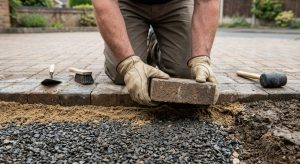
September is a working month for this, while conditions are still dry enough to open ground up and see what is happening.
- Photograph the affected area with a straight edge laid across it, and date the photo. Repeat it in December. Two images beat any amount of guessing about whether movement is seasonal.
- Follow the water. Watch where run-off goes during the next heavy shower rather than after it, since standing water tells you where it ended up rather than how it got there.
- Clear gullies and channel drains, and check that downpipes still discharge where they were meant to. Several of the checks worth making on driveway drainage apply just as well to patios.
- Lift one or two blocks at an edge and look at the material underneath. Loose, wet or fine material where compacted stone should be answers most questions immediately.
- Resist topping up a dip with sand or fresh jointing. It hides the movement without slowing it, and it makes the eventual repair harder to price.
Repair, Relay or Rebuild
Where the base is sound and the movement is seasonal, a localised lift and relay is usually enough, sometimes with drainage improved at the same time. Where the base has been washed out or was never adequate, relaying the same surface over it buys a year at most. Where a leak is involved, the pipework gets fixed first and the paving second, in that order, or the repair simply fails again.
Ominiworks looks at the ground before quoting on the surface, because the surface is rarely the thing that moved. If your patio or driveway has shifted since the rain returned, call 0800 999 1367 or arrange a free site survey and we will tell you which of the three you are actually dealing with.
