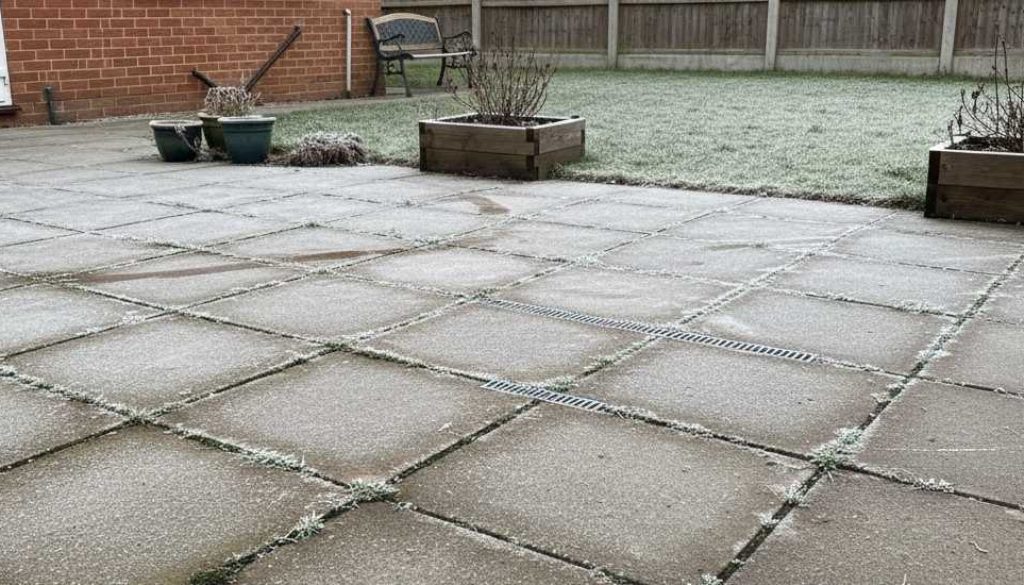
How Frost and Heavy Rain Affect Your Patio (And What to Do Now)
Winter rarely destroys a patio overnight. Damage usually begins quietly.
Water seeps into joints. Temperatures drop. The moisture freezes, expands, and shifts what once felt solid. Add weeks of heavy rain, and the ground beneath weakens further.
By early spring, what looked like a stable surface may already be under stress.
Understanding patio frost damage, winter patio problems, and drainage issues in patios allows you to act before minor movement becomes structural failure.
How Frost Causes Structural Stress
Frost damage is not about surface ice. It is about what happens beneath the surface.
The Freeze-Thaw Cycle Explained
Water expands by roughly nine percent when it freezes. When moisture enters joints or porous materials, freezing temperatures force expansion.
This expansion creates pressure within:
- Jointing compounds
- Natural stone pores
- Bedding layers
- Sub-base structures
When temperatures rise again, the ice melts and contracts. Repeated cycles cause gradual weakening.
Over time, this leads to:
- Hairline cracks
- Loose slabs
- Joint erosion
- Edge separation
Patio frost damage is rarely dramatic at first. It begins subtly and compounds with each cycle.
Heavy Rain Saturates the Sub-Base
Winter patio problems are rarely caused by frost alone. Prolonged rainfall plays a major role.
When drainage is insufficient, water collects beneath the paving.
What Happens When the Base Becomes Saturated
A saturated sub-base loses load-bearing strength. This can result in:
- Minor settlement
- Surface dipping
- Rocking slabs
- Uneven edges
In areas with higher rainfall, drainage issues in patios become more common. Soil retains moisture, increasing pressure during freeze periods.
Even premium paving materials cannot compensate for weakened ground beneath.
Early Signs of Winter Patio Problems
You do not need major cracks to confirm damage. Small indicators often appear first.
Check for:
- Slight dips forming after rainfall
- Water pooling in specific spots
- Crumbling or loose joints
- Moss growth concentrated in low areas
- Movement when stepping on certain slabs
These are early warnings.
Ignoring them allows structural movement to continue unnoticed.
Why Drainage Issues in Patios Worsen After Winter
Drainage performance is tested most during winter.
Blocked channels, insufficient fall, or poorly compacted sub-base become obvious under heavy rainfall.
If water lingers for extended periods, frost intensifies its impact.
Drainage issues in patios are often revealed during late winter and early spring, making this the ideal time for inspection.
A well-built patio disperses water efficiently. A rushed installation allows saturation.
How Different Materials React to Frost
While ground conditions matter most, material choice influences surface durability.
Natural Stone
Porous stone can absorb water if not sealed properly. During freeze-thaw cycles, this absorption increases risk of surface flaking.
Concrete Slabs
Concrete with lower density may develop surface scaling over time if water penetration occurs.
Porcelain
Porcelain has low absorption rates, reducing frost risk at surface level. However, even porcelain depends entirely on stable groundwork beneath.
Material selection supports performance. It does not replace structural preparation.
What to Do Now: A Practical Inspection Guide
Late winter and early spring are ideal for assessment.
Follow this simple process:
1. Inspect After Rainfall
Check for pooling areas once the rain stops. Standing water indicates fall or drainage concerns.
2. Walk the Surface Slowly
Feel for slight movement or rocking. Subtle instability suggests base settlement.
3. Examine the Edges
Edge restraints prevent lateral spread. If gaps appear or edging feels loose, support may be compromised.
4. Check Joint Integrity
Loose jointing compound or excessive sand displacement points to water infiltration. Early identification reduces the need for full reconstruction.
When Repairs Are Enough and When They Are Not
Minor joint erosion or surface staining can often be addressed through maintenance.
However, if movement is visible or settlement continues, structural correction may require:
- Lifting affected sections
- Recompacting sub-base
- Improving drainage
- Reinforcing edges
Quick patching rarely solves underlying winter patio problems if ground conditions are unstable.
A Seasonal Reminder
In areas with varied terrain and established properties, seasonal weather impact can differ between gardens.
For homeowners reviewing Bath patios after winter, pay close attention to how slopes handle rainfall. Uneven settlement often appears along gradients where water flow concentrates.
Older garden layouts may conceal subtle drainage weaknesses. Winter exposes them. A careful seasonal check protects long-term stability.
Why Professional Assessment Matters
Surface damage is often a symptom rather than the cause.
At Ominiworks, post-winter inspections focus on:
- Sub-base integrity
- Drainage flow
- Soil behaviour
- Edge stability
Rather than treating visible cracks alone, the focus remains on structural health.
Addressing patio frost damage early prevents deeper reconstruction later.
Heavy rain and freezing temperatures are part of the UK climate. Proper preparation and responsive maintenance reduce their long-term impact.
Protect Your Patio Before Spring Use Begins
Frost and heavy rain affect patios gradually, not instantly. Early spring is the window to evaluate, correct, and strengthen before increased foot traffic and outdoor use begin.
If you suspect winter patio problems or notice drainage issues in patios around your property, arrange a professional site review.
Ominiworks provides detailed assessments and clear guidance on whether simple maintenance or structural correction is required.
Winter reveals weaknesses. Spring is the time to fix them properly.